

Shoplife Africa Network
An e-commerce and digital media platform for all Africa to trade, learn and earn
8 members· by @shoplifeglobal

10/12/2026, 11:40:45 AM
Standard Bank Invests in OPay as Fintech Giant Moves Towards a US IPO: What It Means for Africa’s Digital Economy By Dayo Olashoplife There was a time when building a successful financial institution in Africa meant opening bank branches, acquiring banking licences and convincing customers to trust you with their money. Today, the story is changing. Some of the most interesting developments in African finance are happening on mobile phones, through digital platforms that allow people to send money, pay bills and run businesses without visiting a traditional bank. OPay is one of the companies at the centre of this transformation. And its latest development could be an important moment not only for the company but also for the future of financial technology in Africa. On October 9, 2026, South Africa's Standard Bank Group announced that it had signed an agreement to invest in OPay as the Nigerian-focused fintech company prepares for a proposed initial public offering (IPO) on the New York Stock Exchange. The investment, to be made through Stanbic Africa Holdings, is subject to the completion of the IPO and applicable regulatory approvals. According to OPay's preliminary prospectus, the investment is capped at the lowest of $200 million, an amount linked to Standard Bank's qualifying regulatory capital, or the value of a 4.99 per cent stake in OPay. The agreement also opens the door to a broader commercial relationship between the two companies. It is a significant development because it brings together two different approaches to financial services: the established banking infrastructure of one of Africa's largest financial groups and the digital distribution network of a fintech that has built a substantial presence in Nigeria. But to understand why this matters, we need to look beyond the investment figure. Why Is Standard Bank Interested in OPay? Standard Bank is not simply buying into a popular financial app. It is positioning itself to participate in the next phase of Africa's digital financial economy. Traditional banks have established infrastructure, regulatory experience, financial products and access to capital. Fintech companies, on the other hand, often have the advantage of reaching customers through technology, mobile applications and digital payment networks. OPay has built its business around making financial services accessible through a digital platform. Its services include payments, money transfers, merchant solutions and other financial products. For a bank like Standard Bank, an investment in OPay could provide access to a large network of consumers and businesses who already use digital financial services. Instead of building every customer relationship from scratch, a traditional bank can explore ways to distribute selected products through an existing digital platform. Standard Bank and OPay have indicated that they intend to explore opportunities involving digital banking and the distribution of selected Standard Bank products and services through OPay's consumer and merchant network. Potential areas of collaboration include payments, merchant services, lending and remittances. These opportunities are still subject to further development and implementation. Nevertheless, the direction is clear: the future of banking may increasingly depend on partnerships between established financial institutions and technology-driven platforms. OPay's IPO: A New Chapter for African Fintech An initial public offering is the process through which a private company offers shares to public investors and seeks to have those shares traded on a stock exchange. For OPay, the proposed IPO represents an opportunity to enter the international public capital market. The company has filed a registration statement with the United States Securities and Exchange Commission and applied to list American Depositary Shares on the New York Stock Exchange under the proposed ticker symbol OPAY. American Depositary Shares, or ADSs, allow investors to gain exposure to shares in a foreign company through securities traded in the United States. However, the filing is an important distinction: OPay has proposed an IPO, but the filing itself does not mean that the offering has been completed. As of the preliminary prospectus, the number of shares to be offered, the final offer price and the expected proceeds had not been disclosed. There has been speculation about a possible valuation of approximately $4 billion. That figure should not, however, be treated as OPay's confirmed IPO valuation. The final valuation will depend on the terms of the offering and the price investors are willing to pay. For OPay, a successful listing could provide access to a wider pool of investors, increase its international visibility and create a public-market valuation for its business. It would also bring greater scrutiny. Public investors typically want detailed information about revenue, profitability, business risks, corporate governance and future growth. In other words, an IPO is not simply a celebration of how far a company has come. It is also an opportunity for the market to decide what the company is worth and whether it can sustain its growth. What Does the Investment Tell Us About Nigeria? One of the most interesting aspects of this development is the importance of the Nigerian market to OPay's business. Although the company has operated in other markets, Nigeria remains central to its operations and financial performance. That makes the country an important part of the investment case for Standard Bank. Nigeria has a large population, a substantial informal economy and millions of consumers and businesses who need convenient ways to move money and make payments. For small businesses, traders and independent entrepreneurs, digital financial platforms can reduce the friction involved in collecting payments, transferring funds and managing everyday transactions. This creates an opportunity for companies that can build reliable financial services around the needs of these customers. But the same concentration also presents a risk. A significant dependence on one market exposes a company to that country's regulatory decisions, economic conditions, currency movements and competitive environment. OPay's continued success will therefore depend not only on acquiring users but also on maintaining trust, complying with regulations and developing sustainable sources of revenue. The opportunity is substantial, but so is the responsibility that comes with operating at scale. Is This the Beginning of a New Relationship Between Banks and Fintechs? For years, discussions about financial technology have often presented banks and fintech companies as competitors. Fintech companies were expected to challenge traditional banks by delivering faster, more convenient digital services. Banks, meanwhile, possessed the capital, licences and infrastructure needed to operate within established financial systems. The relationship is becoming more complicated. Rather than competing in every area, the two sides can benefit from working together. A fintech can provide customer reach, digital engagement and technology. A traditional bank can contribute financial products, institutional relationships, risk-management capabilities and experience operating within complex regulatory environments. The Standard Bank–OPay arrangement could become an example of how these strengths might be combined. If the planned collaboration develops successfully, OPay users and merchants could eventually gain access to additional financial products, while Standard Bank could reach customers through a digital channel. However, the proposed benefits should not be confused with completed products or guaranteed outcomes. The companies will still need to determine how any collaboration works in practice. The broader lesson is that the future of financial services may not belong exclusively to traditional banks or independent fintech companies. It may belong to platforms that can combine technology, distribution, financial infrastructure and customer trust. The Bigger Opportunity: Turning Digital Networks into Financial Infrastructure There is a deeper lesson in this development for entrepreneurs building technology businesses in Africa. A digital platform becomes more valuable when it can do more than attract users. Its long-term potential increases when it becomes part of the activities through which people earn, spend, exchange and manage money. Consider the journey of a small business owner. The business owner may begin by using a digital platform to reach customers. Over time, the platform could help the business owner collect payments, pay suppliers, manage subscriptions and access other financial services. What begins as a technology product can gradually become part of the infrastructure supporting everyday commerce. The same principle applies to creators, musicians, writers and other independent professionals. A platform that helps creators publish content may attract an audience. But a platform that also supports subscriptions, payments, digital products, royalty distribution and business transactions can serve a much broader economic purpose. This is where the distinction between a digital service and a digital financial network becomes important. A service solves a particular problem. A network can connect multiple participants and enable transactions between them. The more useful those connections become, the greater the opportunity to build a sustainable business around them. OPay's proposed IPO and its agreement with Standard Bank highlight the commercial importance of this relationship between digital distribution and financial services. For African technology entrepreneurs, the question is not simply how to build another app. It is how to create products that become useful parts of the economic lives of their customers. What Should Investors Watch? Despite the excitement surrounding OPay's proposed listing, investors should approach the opportunity with the same discipline they would apply to any other business. Several questions deserve attention. First, how sustainable is the company's profitability? Rapid growth in users and transactions can be encouraging, but investors also need to understand the costs of acquiring customers, maintaining the platform and generating revenue from its activities. Second, how concentrated is the business geographically? Nigeria offers considerable opportunities, but a heavy dependence on one market can expose the company to local economic and regulatory risks. Third, can OPay continue to expand its financial products responsibly? Offering additional services could increase revenue per customer, but lending, payments and other financial activities require effective risk management and regulatory compliance. Fourth, what valuation will the IPO establish? Even a promising company can be an unattractive investment if its shares are priced too highly relative to its earnings, growth prospects and risks. Finally, investors should examine the final prospectus, including the company's financial statements, ownership structure, risk disclosures and the terms of the offering. Standard Bank's participation is an important development, but institutional investment alone does not guarantee future returns. A Milestone, Not the Finish Line The proposed investment in OPay reflects a growing recognition that digital financial platforms can play an important role in the future of African banking. For Standard Bank, the transaction offers a potential opportunity to deepen its participation in digital financial services through a platform with significant reach in Nigeria. For OPay, the proposed IPO could open a new chapter in its development, bringing access to public-market investors and greater international visibility. For Nigeria and the wider African technology ecosystem, the development provides another example of how homegrown digital businesses can attract the attention of major financial institutions. But the real test will come after the announcements. Can OPay maintain customer trust, grow sustainably and manage its risks? Can Standard Bank turn its proposed investment into a productive commercial partnership? And can the broader fintech industry use digital distribution to deliver more accessible, reliable and valuable financial services? These are the questions that will determine the long-term significance of the deal. One thing is clear: Africa's digital economy is evolving beyond the idea of technology as a tool for convenience. Increasingly, technology is becoming a way to connect people, businesses and money. And as that transformation continues, the companies best positioned to succeed may be those that understand that the real value of a digital platform lies not merely in how many people use it, but in how meaningfully it participates in the economy those people are building.

7/19/2026, 6:54:20 PM
What is your oen idea of the next wave of online commerce
e-commerce is gradually changing with the advent of AI. What do you forsee for digital commerce of the future? Kindly leave your comment below
6/17/2026, 5:34:28 PM
Dangote anouced a $7 Billion Business Expansion Project to Strengthen Food Security Africa's future food security will depend not only on what we grow, but on what we produce. We are pleased to announce Africa Finance Corporation's support for a US$7 billion expansion programme

↻ Repost
6/16/2026, 5:53:58 PM
I an Free, free at last
At the mention of His name, chains are broken
6/13/2026, 12:59:09 PM
How true is this
If I were looking for a billion-dollar opportunity over the next 5–10 years, I would focus on one of these three themes: AI agents that do work for people Financial products for underserved groups Platforms that turn reputation, creativity, or digital assets into money
6/9/2026, 6:30:22 PM
The 5 Ds of Destiny
1. Design 2. Discovery 3. Development 4. Decisions 5. Divine help
6/4/2026, 1:39:00 PM
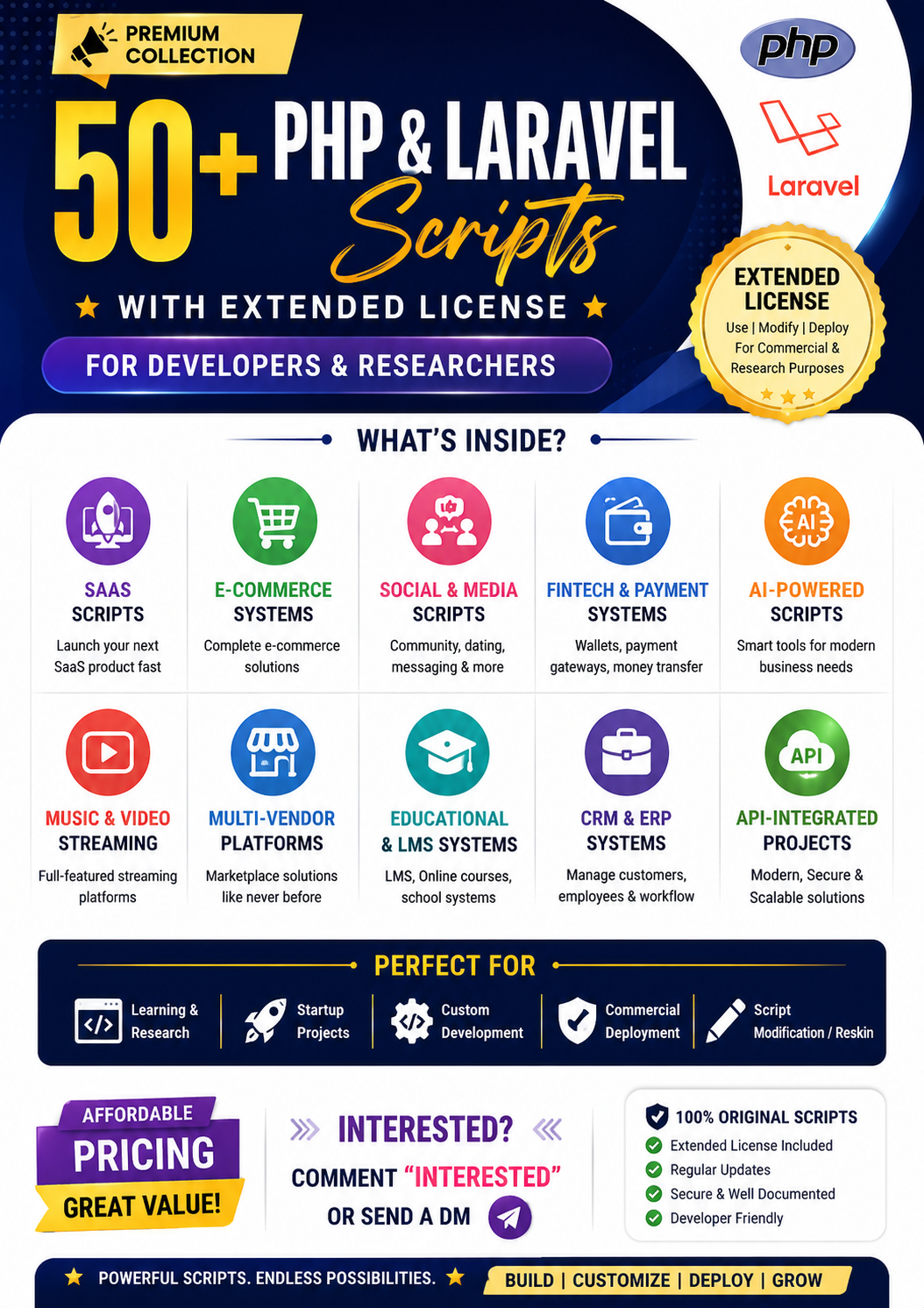
50+ PHP and Laravel script with Extended License for Sale
I currently have a collection of 50+ premium PHP & Laravel scripts with Extended License suitable for developers, startups, researchers, and learning purposes. https://shoplife.com.ng/product/50-php-and-laravel-script-with-extended-license-for-sale/

6/4/2026, 1:27:29 PM
Perfect heart is the language of Love
When you are in love with your husband with a perfect heart, he unveils to you things to you without begging. You must prove the sincerity of your love 2 Corinthians 8:8


5/26/2026, 3:13:57 PM
Sometimes, indifference and neglect are better weapons than aggression against your enemy
↻ Repost
5/22/2026, 7:46:28 AM
Overcoming Life's Challenges with Relentless Resourcefulness
Like it or not, we face many challenges in life. That’s why you need a trait that can help you overcome them. The trait is being resourceful. I learned about it when I read an essay by Paul Graham, the co-founder of Y Combinator, a startup incubator. In the essay, he wrote about the trait you need to succeed as a startup founder. He summed it up in just two words: relentlessly resourceful. You must become relentlessly resourceful to succeed as a startup founder. Thinking about it, I believe that the trait is important not just for startup founders, but for everybody. We all face challenges in life, and being resourceful can help you overcome them. What does it mean to be resourceful? The dictionary defines resourceful as “having the ability to find quick and clever ways to overcome difficulties.” Based on that definition, there are two characteristics of being resourceful: Quick. You quickly grasp the situation and make a decision. You are responsive to changing situations. Clever. You find a clever way to overcome challenges. You find a creative solution instead of just doing what everyone else is doing. So, how can we have these qualities? I’m sure there are other ways, but here are some: 1. Keep an idea journal. Keeping an idea journal is one of the most important things you can do to become resourceful. There are at least two benefits of doing this: It helps you recall your ideas. You can easily find the ideas you got months or even years ago. You won’t lose any of them. It helps you get more ideas. Why? Because by having a habit of recording ideas, you will become more attentive to ideas. You will spot ideas better than before. Use the journal to record all your ideas, not just the ones related to your current challenge. An idea that might not seem useful now might become invaluable later. 2. Brainstorm. When you are looking for a way to overcome a challenge, don’t try to come up with a perfect solution. Doing so might hinder you from coming up with anything at all. Instead, just write down all the possible solutions you can think of. After you are done with that, then you can start evaluating the ideas to find the best one. 3. Take risks. To do something creative, you may need to experiment with new things. That requires taking risks. Yes, you might fail. But there is a good chance that you will find a clever way to overcome your difficulties. The willingness to take risks also helps you become quick. If you wait until everything is certain, then the opportunity might disappear. 4. Read diversely. A good way to get creative ideas is to combine ideas from different fields. By reading diversely, you will have a cross-pollination of ideas going on in your mind. A new connection could form that gives you a novel solution to your challenge. 5. Meet different kinds of people. The people you know can give you either the ideas or the resources you need. The more kinds of people you know, the higher the chance that you will find the right person. 6. Set constraints. One way to push yourself to get clever ideas is to set constraints. For example: try giving yourself just three days to finish a task that normally would take a week. The constraint will push you to be creative. *** I’m sure there are other ways to become resourceful. So I’d like to ask you: What tips do you have for becoming resourceful? Feel free to share your thoughts in the comments. As seen on Lifeoptimizer.org

5/16/2026, 5:51:30 PM
Be a man of Value and you will attract wealth
PURSUE VALUE. We should not try to get everythiing now. When I went to college, spent 8years in the University. I have 3 bachelor's degrees, Master degrees and 5 other degrees. Many of my friends that where in school with me went straight to jobs, while I went to college. They started making money early, I delayed making money for years. And now, what they are making a year, I probably make it an hour. We need to be more focus on developing ourselves rather than trying to grab the money now. Focus on self improvement, self expansion rather than trying to get your pocket expand. Because the more valuable you make yourself, the more value you attract. You are not pay for the amount you worth, you are paid for which you are worth to the organisation. So, the more intellectual development you have, the more spiritual development you have, the more psychological development you have,emotional stability, you become more valuable to the world. If you become valuable to the world, the world will pay you to be yourself. So it is important to become a person of value, not to seek value in things. I get paid for what I know, not what I do. I want to encourage our young people to focus on discovering the purpose for your life(why God created you). And then discover your gift and then, refined them, develope them, practice them and even begin to serve them freely to your community. Develope yourself. In a short time, you will discover that people will pursue you. Just like a tree, trees never bring their fruits to you, they simply manifest them. You are attracted to the tree. So, when you develope your gift, you don't need to look for followers, they will find you. Kindly like and share to bless others, God bless you. - Dr Myles Munroe - Spiritual Notes